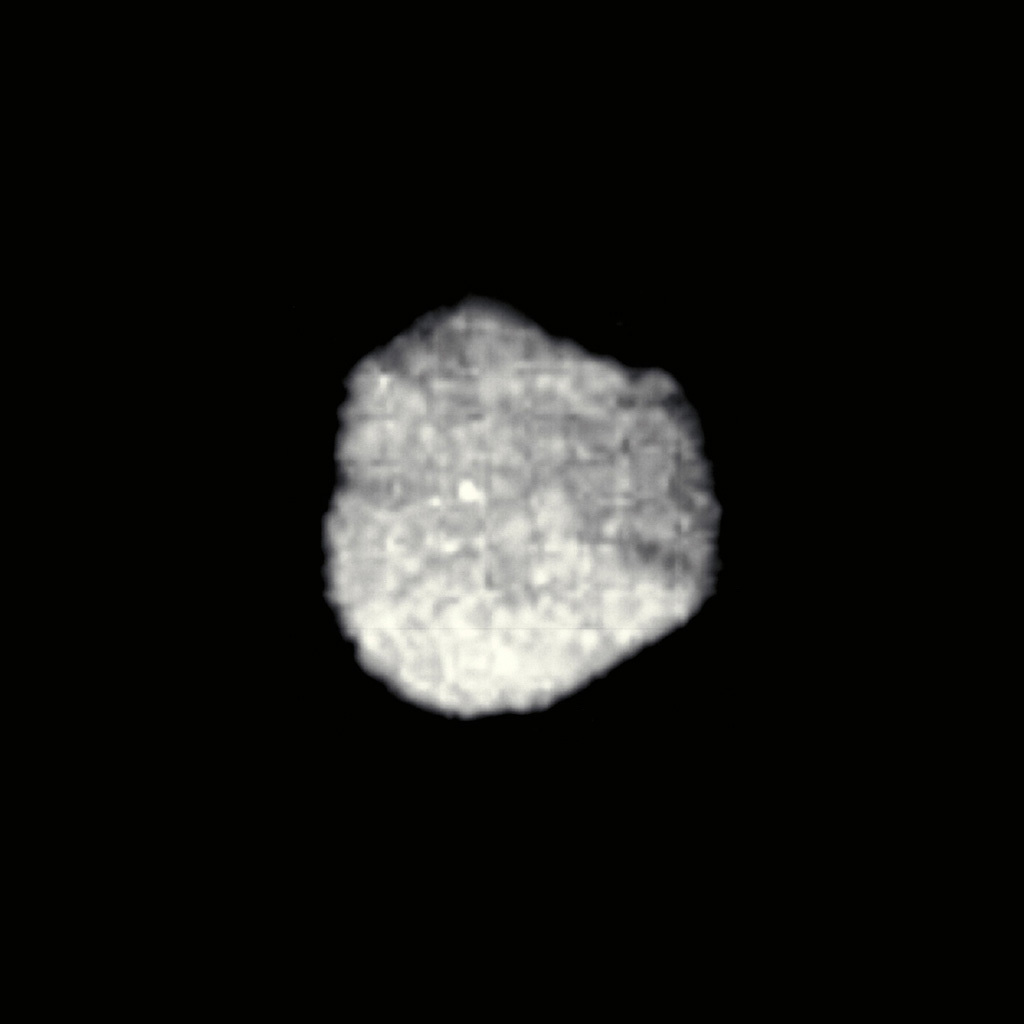
Proteus, a moon of Neptune

Hippocamp
Proteus
Triton

Proteus from Voyager 2 in 1989, image credit: NASA/JPL
Classification
Natural satellite of Neptune
Average distance from Neptune
117,647 km
73,102 miles
Diameter across equator
420 km
261 miles
Time to orbit Neptune
27 hours
Year of Discovery
1989
Origin of Name
In Greek mythology, Proteus was a shape-shifting sea god with the power to foretell the future

Proteus is a moon of Neptune. It is one of Neptune's inner moons and is the seventh moon to orbit the planet. It is the outermost of Neptune's inner moons. Proteus has a diameter of approximately 420 kilometres (261 miles) and is Neptune's second largest moon. It orbits Neptune at a distance of about 117,650 kilometres (73,100 miles). It takes about 27 hours for Proteus to complete an orbit of Neptune.

Proteus isn't thought to be an original moon of Neptune. Instead, it is a moon that reformed after the destruction of an earlier moon. It is thought that Proteus originally formed much closer to Neptune than its current position moved moved outwards.

Proteus is classed as a regular prograde moon. Regular moons are moons that formed out of materials spinning around a planet. Irregular moons are ones that were captured by a planet. A prograde moon is one which orbits in the same direction of the rotation of its host planet.


Why is Proteus called Proteus?

In Greek mythology, Proteus is a sea-god that can see into the future and change his shape. He would use his shape-shifting skills to attempt to get out of foretelling the future, but if this didn't work, he'd return to his original form. He looks after Poseidon's seals.

As Neptune is the Roman god of the sea, all of its moons have water-related names.

Proteus is also known as Neptune VIII or by its provisional name, S/1989 N 1.


Hippocamp
Proteus
Triton
Explore this section ↑
Twitter X logo Facebook logo Email icon
© 2000 - 2026 SULTANA BARBECUE