
Saturn's Rings

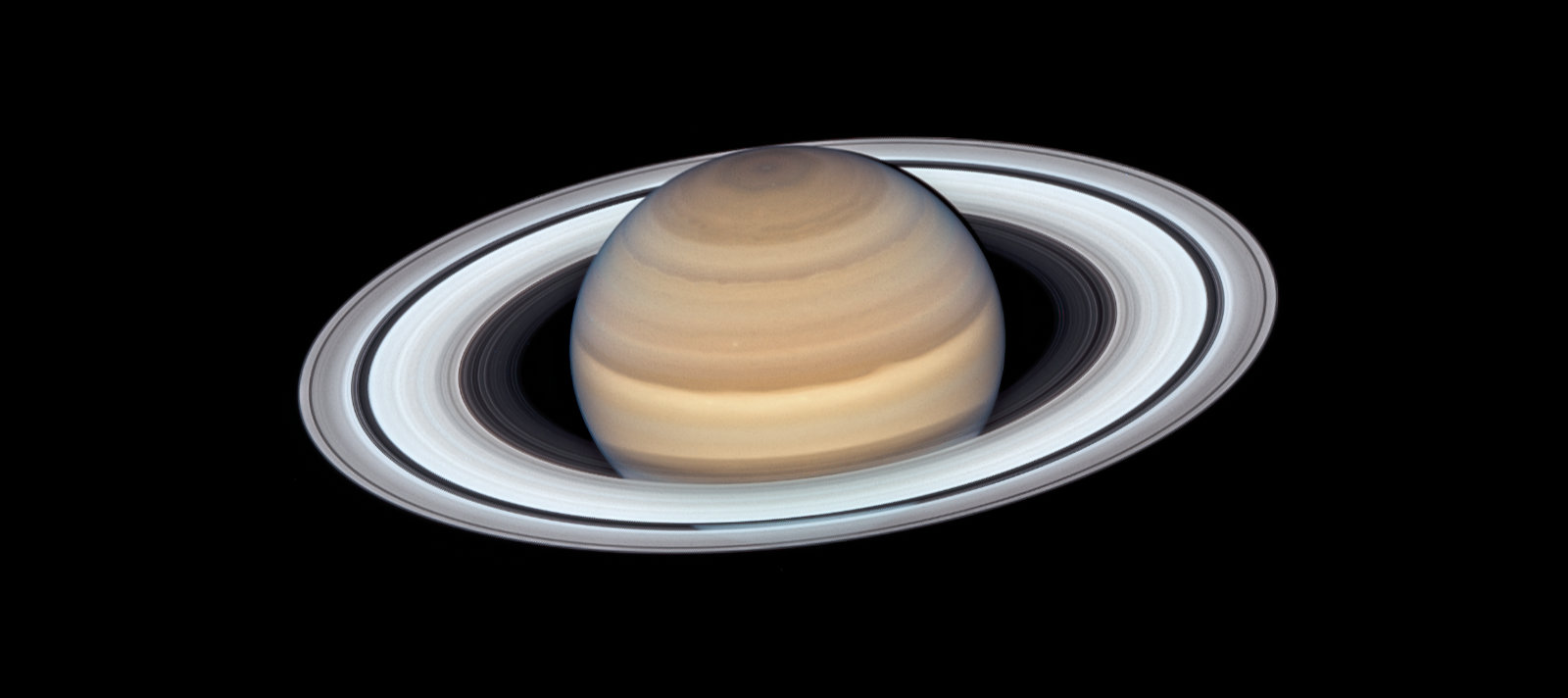
Saturn has the most spectacular rings in the Solar System. They stretch far out from the planet, making Saturn look as if it is wearing a giant cosmic hula hoop. Very stylish.
From far away, Saturn’s rings look like smooth, solid bands. Close up, they would be very different. The rings are made from countless separate pieces of ice, rock and dust, each travelling around Saturn in its own orbit. Some pieces are tiny, while others are much larger, but together they create one of the most famous sights in space.
Saturn's Rings - At a Glance
- Saturn has the largest and brightest ring system in the Solar System.
- The rings are made mostly from water ice, mixed with rock and dust.
- Ring particles range from tiny grains to chunks as large as houses, with a few even larger pieces.
- The rings are extremely wide, but in many places only about 10 metres thick.
- Some small moons help shape and control parts of the rings.
- Saturn is slowly losing ring material in a process sometimes called ring rain.
Galileo Galilei was the first person known to have seen Saturn’s rings through a telescope in 1610. Unfortunately, his telescope was not powerful enough to show what they really were. He thought Saturn might have two large moons, handles or strange bulges on either side of it.
A few decades later, Christiaan Huygens worked out that Saturn was surrounded by a thin, flat ring. Giovanni Cassini later discovered that the ring system was not one single smooth ring, but was divided into separate parts with gaps between them.
So Galileo saw something strange, Huygens worked out what it was, and Cassini helped reveal that the rings were more complicated than they first appeared. Very much a team effort, spread across several confused astronomers.
What are Saturn's rings made of?
Saturn’s rings look like smooth, solid bands from far away, but they are made from countless pieces of ice, rock and dust, all travelling around Saturn in their own orbits.
Most of the material in the rings is water ice. This is one reason Saturn’s rings shine so brightly: the icy particles reflect sunlight. Some parts of the rings look brighter than others because they contain more material, cleaner ice, or particles packed more densely together. Fainter parts may contain less material, smaller particles, or more dust mixed in.
The pieces in the rings come in many sizes. Some are tiny grains, while others are as large as boulders, cars or houses. A few may even be as large as mountains. Together, they form the wide, flat ring system that makes Saturn so distinctive.
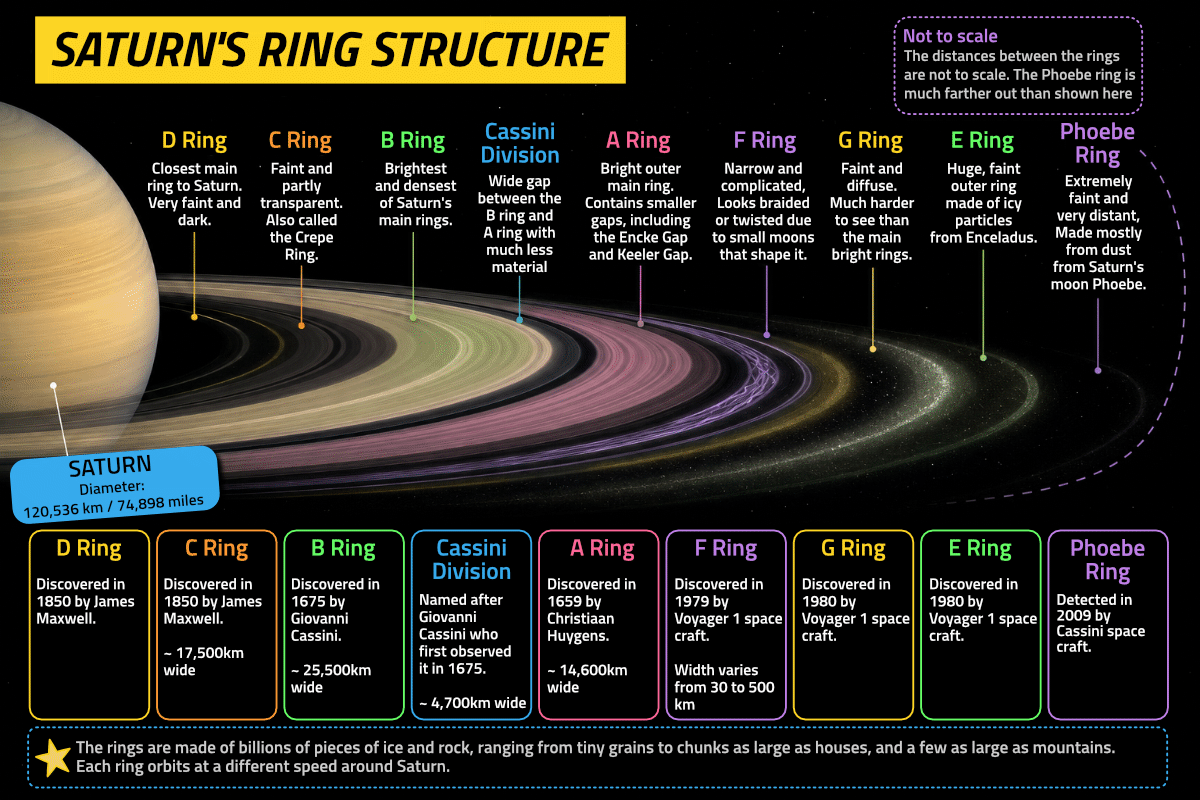
Saturn’s rings are not just one single ring. They are divided into several main sections, usually labelled with letters. The letters do not match their order from Saturn. They were named in the order they were discovered, not in the order they appear from the planet. Very helpful.
Some parts of the ring system are separated by gaps or divisions. They are areas where there is much less ring material, often because the gravity of Saturn’s moons has disturbed the particles there.
Starting at Saturn and moving outward, the ring system is roughly arranged like this:
- D ring - the closest main ring to Saturn. It is faint, dusty and difficult to see.
- C ring - a faint, partly transparent ring sometimes called the Crepe Ring because of its dusky appearance.
- B ring - the brightest and densest of Saturn’s main rings. This is one of the most obvious parts of the ring system.
- Cassini Division - a wide, dark-looking gap between the B ring and A ring. It is not completely empty, but it contains much less material than the rings around it.
- A ring - a bright outer main ring beyond the Cassini Division. It contains smaller gaps, including the Encke Gap and Keeler Gap.
- F ring - a narrow, complicated ring just outside the A ring. It can appear braided or twisted because it is shaped by the gravity of small moons nearby.
- G ring - a faint ring beyond the F ring. It is much harder to see than Saturn’s main bright rings.
- E ring - a huge, faint outer ring supplied by icy particles sprayed into space by Saturn’s moon Enceladus.
- Phoebe ring - a huge, faint outer ring thought to be made mostly from dust knocked off Saturn's moon Phoebe, although other distant moons may add some material too. By this point, astronomers seem to have wandered away from the alphabet idea. Probably wise.
Saturn’s rings also have some strange features. Spacecraft have seen faint, dark markings called spokes, which appear across parts of the rings and then fade away. These are thought to be linked to tiny dust particles affected by Saturn’s magnetic field. So even Saturn’s rings have weather, sort of. Space weather. Very fancy.
How big are Saturn's rings?
Saturn itself is about 120,536 kilometres wide across its equator. Its ring system stretches much farther out, reaching up to about 282,000 kilometres from the planet. That makes Saturn’s rings one of the largest and most spectacular structures in the Solar System.
The strange thing is that Saturn’s rings are extremely thin compared with how wide they are. The main rings spread across an enormous distance, but in many places they are only about 10 metres thick. That means Saturn’s rings are not like a chunky bracelet. They are more like an unbelievably wide, flat sheet of icy material.
Because the rings are made from separate particles, there is space between the pieces. A spacecraft could pass through some gaps and less crowded regions, but flying through the main rings would still be risky because the particles are moving incredibly fast.
How did Saturn get its rings?
Scientists are still not completely sure how Saturn’s rings formed. One idea is that they are the remains of a moon, comet or asteroid that broke apart near Saturn. Saturn’s powerful gravity may have torn the object into pieces, spreading the debris out into rings.
Another possibility is that some ring material is left over from objects that never managed to form into a moon. The age of the rings is also still debated. Some evidence suggests they may be relatively young compared with Saturn, while other research suggests they could be much older.
Saturn’s rings are not all made in exactly the same way. The faint E ring is supplied by Enceladus, a small icy moon that sprays water-rich particles into space. These tiny particles spread around Saturn and help form one of its outer rings.
Will Saturn lose its rings?
Saturn’s rings will not last forever. Tiny particles from the rings are slowly falling into Saturn’s atmosphere in a process sometimes called ring rain. Over very long periods of time, this removes material from the rings.
This does not mean Saturn is about to become ringless next week, so there is no need to panic-buy a telescope. The rings may last for many millions of years yet. However, they are temporary features, which means Saturn may not always have looked the way it does today.
Do other planets have rings?
Saturn is not the only planet with rings. Jupiter, Uranus and Neptune also have ring systems, but theirs are much fainter and harder to see. Neptune’s rings are especially unusual because some parts appear as brighter arcs instead of smooth, complete rings.
Jupiter, Saturn, Uranus and Neptune are the Solar System's giant outer planets. Their strong gravity, large families of moons and surrounding icy debris give ring material more chances to form and survive. The smaller rocky planets do not currently have rings, although Mars’s moon Phobos may one day break apart and form a temporary ring around Mars. Astronomers have also found possible ringed planets outside the Solar System, although these are much harder to confirm.
In the Solar System, Saturn still wins the ring competition by quite a distance. Its rings are brighter, wider and more spectacular than the others, which is why they have become the planet’s most famous feature.
Explore this section ↑